
Considerations for Consent

Before making a final decision on whether to collect consent you should talk to your information and governance team and any academic researchers involved in your evaluation, as they may have stipulations around consent.
This flow chart may help those conversations. More details can be found below.
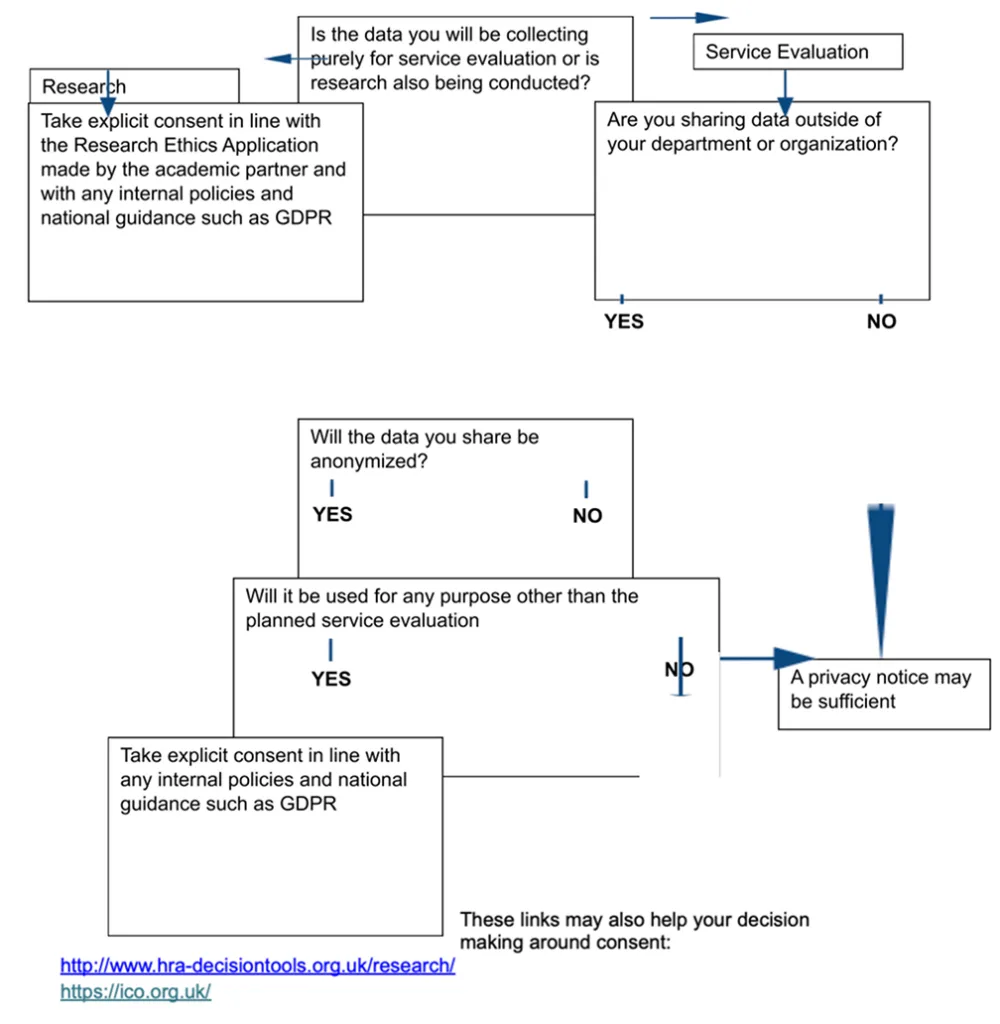
These links may also help your decision making around consent:
The requirements for informed consent in service evaluation are different from research, but it can sometimes be difficult to confidently separate the two. Here are some important points to support your decision making:
When consent is typically NOT required:
Service evaluation that uses routinely collected data for internal quality improvement generally does not require explicit informed consent. This falls under the principle that service providers have a legitimate basis to review their own services. Based on current NHS Health Research Authority guidance, service evaluation can often proceed without formal consent if:
– Data is anonymized or pseudonymized where possible
– It’s part of normal service delivery and improvement
– Participants have been informed generally about how their data may be used (Eg., through privacy notices)
When consent IS required:
- Additional data collection – if you’re asking participants to complete additional questionnaires, undergo extra assessments, or provide information not normally collected, you need consent
- Identifiable data leaving the organisation – if identifiable patient data will be shared with external evaluators or other organisations, explicit consent is usually required, alongside a data sharing agreement
- Sensitive activities – if you are planning activities such as direct observation of consultations, audio/video recording, or particularly intrusive evaluation methods you will require clear consent
Good practice:
Even when formal consent isn’t legally required, transparency is essential. Participants should be informed through privacy notices that their data may be used for service improvement, and they should have the opportunity to opt out. Many organisations adopt a “consent or notification” approach as good ethical practice.
If you’re unsure whether your evaluation requires consent, consulting your organisation’s Caldicott Guardian, information governance team, or getting an opinion from the NHS Health Research Authority can provide clarity.