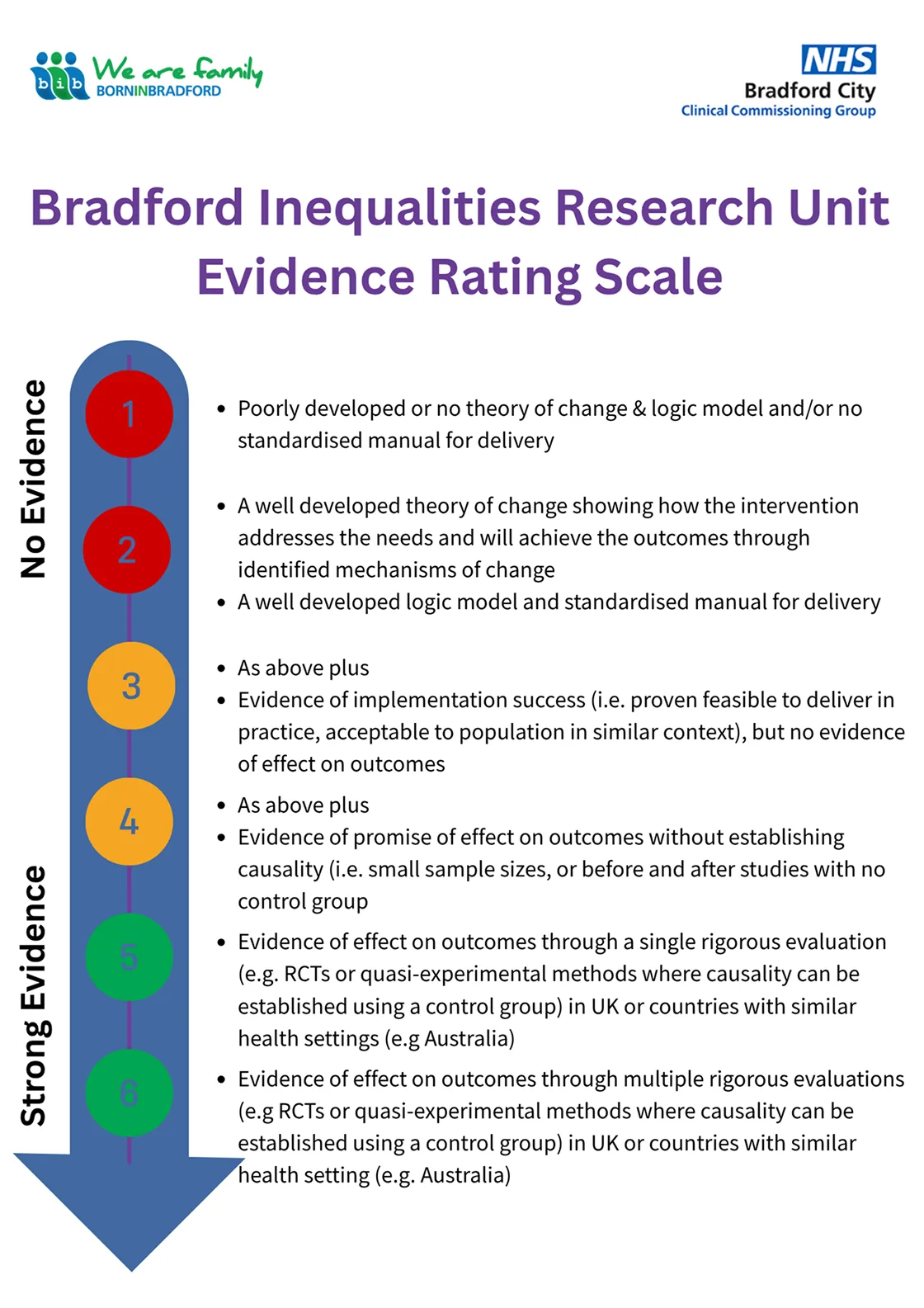
The Bradford Evaluation Framework

How to identify existing interventions

5 minutes

Finding an evidence-based model

Selecting an evidenced-based model saves time in developing something new and means it has already shown promise or had an impact elsewhere. It is significantly easier to replicate an existing model than develop something new and it will come with evidence that can be used to increase buy-in from the community and/or commissioners.

Early Years and Youth Interventions

For those planning services aimed at early years and young people we recommend making use of the Foundations Guidebook as it provides the best source of evidenced based services and includes guidance on how to best use it.

The Foundations Guidebook is a new, updated version of the Early Intervention Foundation’s (EIF) Guidebook.

It contains information on existing research on over 130 services with at least preliminary evidence of improving children and families’ outcomes.

The Guidebook provides reliable evidence to support decision-making across the spectrum of early services for children and families, and children’s social care.

Alternative sources and other demographic groups

Cochrane Library

The Cochrane Library is a collection of high-quality, independent reviews of evidence to inform decision making in health policy and health care. The Cochrane reviews are systematic reviews of the literature – this means that they use an agreed, robust process to identify, appraise, and summarise all the evidence available on a topic. Conclusions are therefore reliable summaries of all the evidence available. The library includes reviews on policy and service approaches to tackle health problems.

Go to website

Campbell Collaboration Library

The Campbell Collaboration promotes the production and use of systematic reviews and other reviews of the evidence to inform policy and practice decisions. It includes reviews of the evidence base in the domains of crime/justice, disability, education, international development, knowledge translation, nutrition, and social welfare. Explore by the co-ordinating group and select reviews. 

Go to website

Evidence 4 Impact (E4I)

E4I reviews evidence for educational programmes. It provides a simple evidence rating system and short summaries of evidence to help people to make an informed judgement on a programme’s effectiveness. The E4I database includes information on the effectiveness and costs of different educational programmes, with links for further support.

Go to website

The National Institute for Health and Care Excellence (NICE)

NICE provides information and guidance for commissioners, practitioners, and managers in health and social care. It produces evidence-based guidance and advice that can be used by groups involved in delivering care or promoting wellbeing, including the NHS, local authorities, employers, and voluntary groups.


Go to website