
Effectiveness evaluation

What is effectiveness evaluation?
An effectiveness evaluation is a rigorous assessment of whether a service achieves its intended outcomes. It uses scientific methods like randomised controlled trials or quasi-experimental designs to establish causal relationships, by comparing outcomes for those who participate with those of a control group to provide evidence of effectiveness. It controls for confounding variables and produces generalisable evidence.
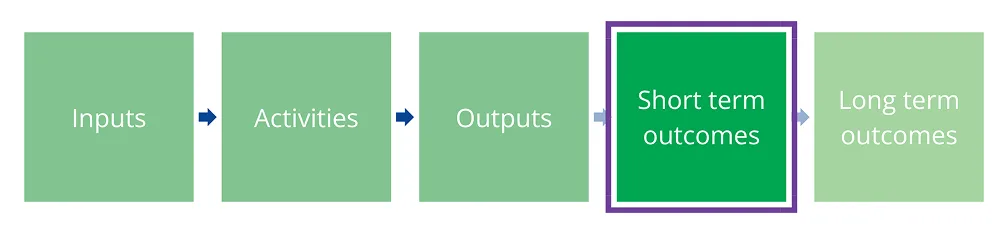
An effectiveness evaluation relates to short to long-term outcomes of your logic model.
Why use an effectiveness evaluation
Effectiveness evaluations do not simply compare outcomes of those that received a service with those that did not. This is because people who receive a service often differ from those who don’t in ways that affect outcomes independently of the service itself. Without accounting for these differences, it’s not possible to tell whether better (or worse) outcomes are due to the service or pre-existing characteristics. This is why rigorous effectiveness evaluations must use methods like randomisation, matching, or statistical controls to create comparable control groups and isolate the true effect of the service.
Effectiveness evaluation requires a researcher
Whilst we strongly advocate effectiveness evaluations, they require scientific rigour and should not be undertaken without an academic partner. We recommend referring to the following section ‘Using an external researcher’ to understand how to prepare for that.